- 15 domestic and international experts, including representatives from three leading international type foundries, participated, strengthening connections with the global design industry
- AI-powered simultaneous interpretation and interactive programs helped overcome language barriers and foster exchanges among creators from Korea and abroad
- Now in its fourth year, the global type design conference reinforced its role as a platform connecting Korea’s type design industry with the international market
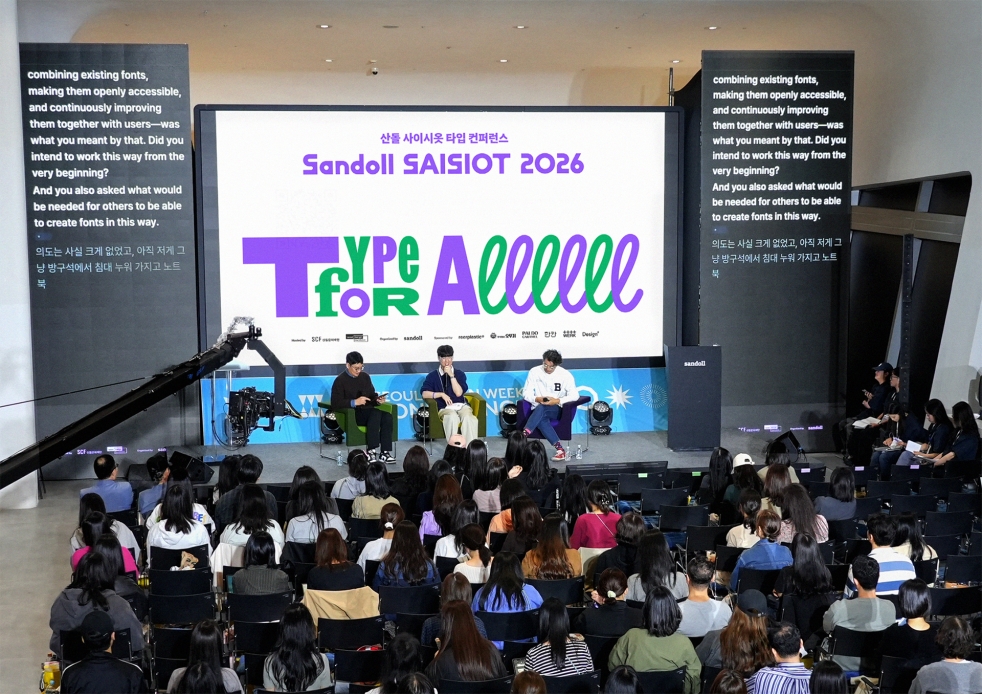
Scenes from “Sandoll Saisiot 2026,” held at DDP Design Lab on October 16–17, 2026
October 19, 2026 (Monday)
The Sandoll Cultural Foundation (Chairman Son Yeon-hong), a nonprofit organization dedicated to promoting and expanding Korean typography and culture, announced on October 19 that “Sandoll Saisiot 2026,” a global type design conference co-hosted with the Seoul Design Foundation and organized by Sandoll Co., Ltd. (CEO Yun Young-ho), had successfully concluded.
Held from October 16 to 17 on the third floor of Design Lab at Dongdaemun Design Plaza (DDP) in Seoul, the event brought together 15 designers and experts from Korea and abroad, including representatives from three leading international type foundries. The Sandoll Cultural Foundation provided a platform for type design professionals to share the latest industry trends and explore future directions, further strengthening connections between Korea’s type design industry and the global market.
Held as part of Seoul Design Week 2026, Sandoll Saisiot marked its fourth edition this year. As a global conference where type design professionals and creators from around the world exchange knowledge and experiences, the event has continued to foster international collaboration and strengthen ties within the global type design community.
Under this year’s theme, “TYPE FOR ALL,” the conference explored ways to make written language more accessible and easier to use for everyone, while examining the role of typography across different linguistic and cultural environments. In particular, the event expanded participation from international experts active in the global type design industry, providing opportunities to share design experiences and technical approaches from diverse language communities and explore new possibilities for type design.
International speakers included Anuthin Wongsunkakon of Thailand-based type foundry Cadson Demak, Jean-Baptiste Levée of France-based Production Type, and Gia Tran of Babelfont, who specializes in multilingual calligraphy.
Drawing on their diverse linguistic and cultural backgrounds, the speakers shared their experiences and perspectives on type design. Their participation provided Korean designers with opportunities to gain insights into global industry trends and engage directly with international experts.
The conference featured three sessions—A, B, and C—over two days, with each presentation followed by opportunities for speakers and attendees to exchange questions and ideas. All presentations were supported by AI-powered simultaneous interpretation subtitles in both Korean and English. This enabled participants from different linguistic backgrounds to better understand the presentations and engage in discussions, demonstrating how technology can improve accessibility in international design exchanges.
The event featured a wide range of perspectives and experiences related to typography. Yoo Ji-won, Director of the Letter Culture Research Institute, and Han Myung-soo, Chief Creative Officer (CCO) of Woowa Brothers, explored the intersection of typography and science and the role of fonts in branding, respectively. International speakers Anuthin Wongsunkakon and Jean-Baptiste Levée shared insights from their experiences in the global type design industry, while Kim Hyun-jin, CEO of POT, and Shin So-hyun, CEO of OIMU, introduced their creative processes and design philosophies. Throughout the sessions, attendees actively engaged with speakers, asking questions about their working methods and creative approaches.
Beyond the lectures, the conference also offered interactive programs that allowed participants to experience type design firsthand and connect with creators. Moving beyond expert-led knowledge sharing, these programs were designed to make type design more approachable for the general public and provide opportunities to discover the value of typography through hands-on experiences.
At the “Saisiot Insight Zone,” participants recorded and shared ideas and inspiration gained from the lectures. The “Library Zone” showcased specimen books and design materials from domestic and international type foundries, while the “Custom Book Zone” invited visitors to create personalized books using various fonts and stories shared by the speakers.
On October 18, the day after the conference concluded, “Seoul Typo Safari” took place in Seongsu and Seochon, Seoul, as part of the accompanying workshop program, “Saisiot Trip.” Guided by lettering designer Kim Do-yeon and illustrator Bari, participants explored the city, observing and documenting typography found in everyday urban environments. The program extended the experience of type design beyond the conference venue and into daily life.
Over the two-day conference, the event attracted visitors from diverse backgrounds, including type design professionals, designers, and members of the general public from Korea and abroad. International participants also took part in the event. Notably, 97% of respondents to the post-event satisfaction survey expressed their intention to participate again, underscoring the conference’s significance as a platform for global type design exchange.
A representative of the Sandoll Cultural Foundation said, “Sandoll Saisiot serves as a global platform where type design professionals from Korea and around the world share their experiences and knowledge while exploring new possibilities in typography together.”
The representative added, “We will continue to connect design professionals across diverse languages and cultures, pursue innovative approaches that combine technology and design, and contribute to the development of Korea’s type design industry and the expansion of global collaboration.”



Scenes from “Sandoll Saisiot 2026,” held at DDP Design Lab on October 16–17, 2026
October 19, 2026 (Monday)
The Sandoll Cultural Foundation (Chairman Son Yeon-hong), a nonprofit organization dedicated to promoting and expanding Korean typography and culture, announced on October 19 that “Sandoll Saisiot 2026,” a global type design conference co-hosted with the Seoul Design Foundation and organized by Sandoll Co., Ltd. (CEO Yun Young-ho), had successfully concluded.
Held from October 16 to 17 on the third floor of Design Lab at Dongdaemun Design Plaza (DDP) in Seoul, the event brought together 15 designers and experts from Korea and abroad, including representatives from three leading international type foundries. The Sandoll Cultural Foundation provided a platform for type design professionals to share the latest industry trends and explore future directions, further strengthening connections between Korea’s type design industry and the global market.
Held as part of Seoul Design Week 2026, Sandoll Saisiot marked its fourth edition this year. As a global conference where type design professionals and creators from around the world exchange knowledge and experiences, the event has continued to foster international collaboration and strengthen ties within the global type design community.
Under this year’s theme, “TYPE FOR ALL,” the conference explored ways to make written language more accessible and easier to use for everyone, while examining the role of typography across different linguistic and cultural environments. In particular, the event expanded participation from international experts active in the global type design industry, providing opportunities to share design experiences and technical approaches from diverse language communities and explore new possibilities for type design.
International speakers included Anuthin Wongsunkakon of Thailand-based type foundry Cadson Demak, Jean-Baptiste Levée of France-based Production Type, and Gia Tran of Babelfont, who specializes in multilingual calligraphy.
Drawing on their diverse linguistic and cultural backgrounds, the speakers shared their experiences and perspectives on type design. Their participation provided Korean designers with opportunities to gain insights into global industry trends and engage directly with international experts.
The conference featured three sessions—A, B, and C—over two days, with each presentation followed by opportunities for speakers and attendees to exchange questions and ideas. All presentations were supported by AI-powered simultaneous interpretation subtitles in both Korean and English. This enabled participants from different linguistic backgrounds to better understand the presentations and engage in discussions, demonstrating how technology can improve accessibility in international design exchanges.
The event featured a wide range of perspectives and experiences related to typography. Yoo Ji-won, Director of the Letter Culture Research Institute, and Han Myung-soo, Chief Creative Officer (CCO) of Woowa Brothers, explored the intersection of typography and science and the role of fonts in branding, respectively. International speakers Anuthin Wongsunkakon and Jean-Baptiste Levée shared insights from their experiences in the global type design industry, while Kim Hyun-jin, CEO of POT, and Shin So-hyun, CEO of OIMU, introduced their creative processes and design philosophies. Throughout the sessions, attendees actively engaged with speakers, asking questions about their working methods and creative approaches.
Beyond the lectures, the conference also offered interactive programs that allowed participants to experience type design firsthand and connect with creators. Moving beyond expert-led knowledge sharing, these programs were designed to make type design more approachable for the general public and provide opportunities to discover the value of typography through hands-on experiences.
At the “Saisiot Insight Zone,” participants recorded and shared ideas and inspiration gained from the lectures. The “Library Zone” showcased specimen books and design materials from domestic and international type foundries, while the “Custom Book Zone” invited visitors to create personalized books using various fonts and stories shared by the speakers.
On October 18, the day after the conference concluded, “Seoul Typo Safari” took place in Seongsu and Seochon, Seoul, as part of the accompanying workshop program, “Saisiot Trip.” Guided by lettering designer Kim Do-yeon and illustrator Bari, participants explored the city, observing and documenting typography found in everyday urban environments. The program extended the experience of type design beyond the conference venue and into daily life.
Over the two-day conference, the event attracted visitors from diverse backgrounds, including type design professionals, designers, and members of the general public from Korea and abroad. International participants also took part in the event. Notably, 97% of respondents to the post-event satisfaction survey expressed their intention to participate again, underscoring the conference’s significance as a platform for global type design exchange.
A representative of the Sandoll Cultural Foundation said, “Sandoll Saisiot serves as a global platform where type design professionals from Korea and around the world share their experiences and knowledge while exploring new possibilities in typography together.”
The representative added, “We will continue to connect design professionals across diverse languages and cultures, pursue innovative approaches that combine technology and design, and contribute to the development of Korea’s type design industry and the expansion of global collaboration.”